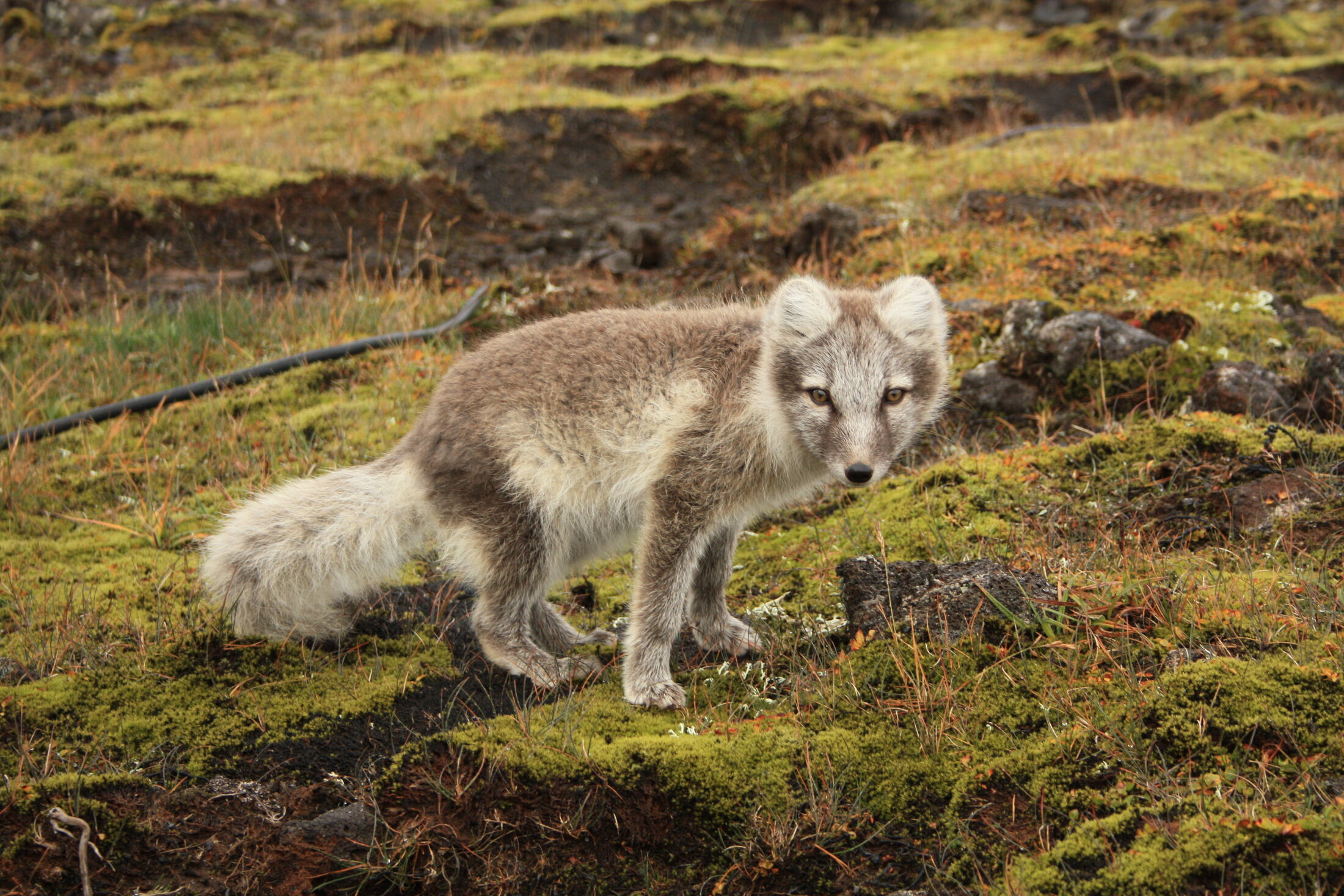
Habitat is a working system
Arctic foxes occur throughout Iceland, from sea cliffs and low coastal valleys to heathland and the open interior. The landscapes look different, but a breeding pair needs the same basic things in each: reliable food, secure den sites, shelter and a territory it can defend.
That makes habitat more than a type of terrain. A productive bird cliff can support several small neighbouring territories. A broad inland valley may offer abundant food in summer but very little in winter. Two places that appear equally wild can therefore have very different value to a fox.
The sea feeds the land
Seabirds, eggs, fish, marine invertebrates and washed-up carrion create a varied food supply. Iceland’s mostly ice-free shoreline can provide something edible throughout the year.
- Generally more varied resources
- Highest densities in western coastal regions
- Marine food carried back to cubs
Life follows the seasons
Migratory geese, waders and passerines dominate the productive months. Ptarmigan, carrion and cached food become especially important through winter.
- Greater seasonal fluctuation
- Food spread across larger areas
- Stronger dependence on bird populations
The coast
Along productive shorelines, the boundary between marine and terrestrial habitat is porous. Food arrives with tides, storms and breeding birds. A fox may forage above a seabird cliff, search the wrack line, take invertebrates in the intertidal zone or find a marine carcass that remains useful for days.
Stable-isotope studies make that connection visible inside the animals themselves. Coastal foxes carry a stronger marine signature and, as a population, use a broader range of foods than inland foxes. Individual animals may still specialise on what their own territory offers; the advantage of the coast lies in the number of possible strategies.
The interior
Inland life runs on a sharper seasonal clock. Summer brings nesting and migratory birds, eggs, insects and berries. As those resources disappear, ptarmigan becomes a central winter prey, supplemented by carrion and food cached during more generous months.
The interior is not necessarily empty or poor, but its resources are less evenly distributed through the year. Early radio-tracking work in Iceland recorded coastal territories of roughly 9–19 square kilometres and indicated that inland territories could be larger. The governing principle is simple: when useful food is scattered, a pair needs more ground.
A den is infrastructure
A den is primarily a nursery. The female gives birth there, the young wait there, and both parents repeatedly return with food. A territory may contain several dens, allowing a family to move if disturbance, weather or local conditions make one site less suitable.
Good denning ground is not available everywhere. Foxes can enlarge old systems over generations where soil permits digging, but much of Iceland is shallow soil over hard rock. In the northern Westfjords, creating a new den can be especially difficult. Natural cavities, sheltered banks and even abandoned human structures may therefore become valuable parts of the habitat.
Hornstrandir
The 580-square-kilometre reserve combines large seabird cliffs, productive coast and protection from hunting. It supports one of Iceland’s densest fox populations. In the especially rich Hornbjarg cliff area, territories can be as small as 1–2 square kilometres.
Abundance does not make the ground limitless. Thin soil, bedrock, neighbouring territories and hiking paths leave breeding pairs with few alternatives when an established den is disturbed.
Colour has a geography
The distribution of colour morphs adds another layer to the habitat map. Dark blue-morph foxes are most common along the western coast, where they can make up as much as 80 percent of the population. White and blue foxes occur in more equal proportions east of the central highlands, while white animals are more common in parts of the eastern interior.
Camouflage is part of the explanation, but the regional pattern also suggests that many foxes remain tied to particular areas. If animals moved freely and constantly between every part of Iceland, those differences would be harder to maintain.
A map in motion
Habitat can change without its outline moving. A cliff remains a cliff even when fewer seabirds breed on it; an inland valley may look unchanged while the timing and abundance of migratory birds shifts. For foxes, those changes in food can matter more than the visible landscape.
A forty-year study found a comparatively stable, marine-dominated diet among coastal foxes but more variation inland. It also linked declines in seabirds with declines in fox numbers, particularly along the coast. The future is unlikely to be a simple story of better or worse habitat: warming may improve some terrestrial food resources while making marine ones less dependable.
Look for connections, not just foxes
A habitat record begins with the system around the animal: seabird traffic above a cliff, tracks between shore and slope, alarm calls, old den entrances, prevailing wind and the nearest dependable water. Sensitive dens and exact locations should remain undisclosed.
Sources and further reading
The prose above is original and was prepared from the scientific and institutional sources below.
- Natural Science Institute of Iceland — Melrakki
- Hersteinsson & Macdonald — Diet of Arctic foxes in Iceland
- Dalerum et al. — The influence of coastal access on isotope variation
- Páll Hersteinsson — The behavioural ecology of the Arctic fox in Iceland
- Berthelot et al. — Long-term responses to changes in marine and terrestrial ecosystems
- Unnsteinsdóttir et al. — Den attendance under increasing tourism