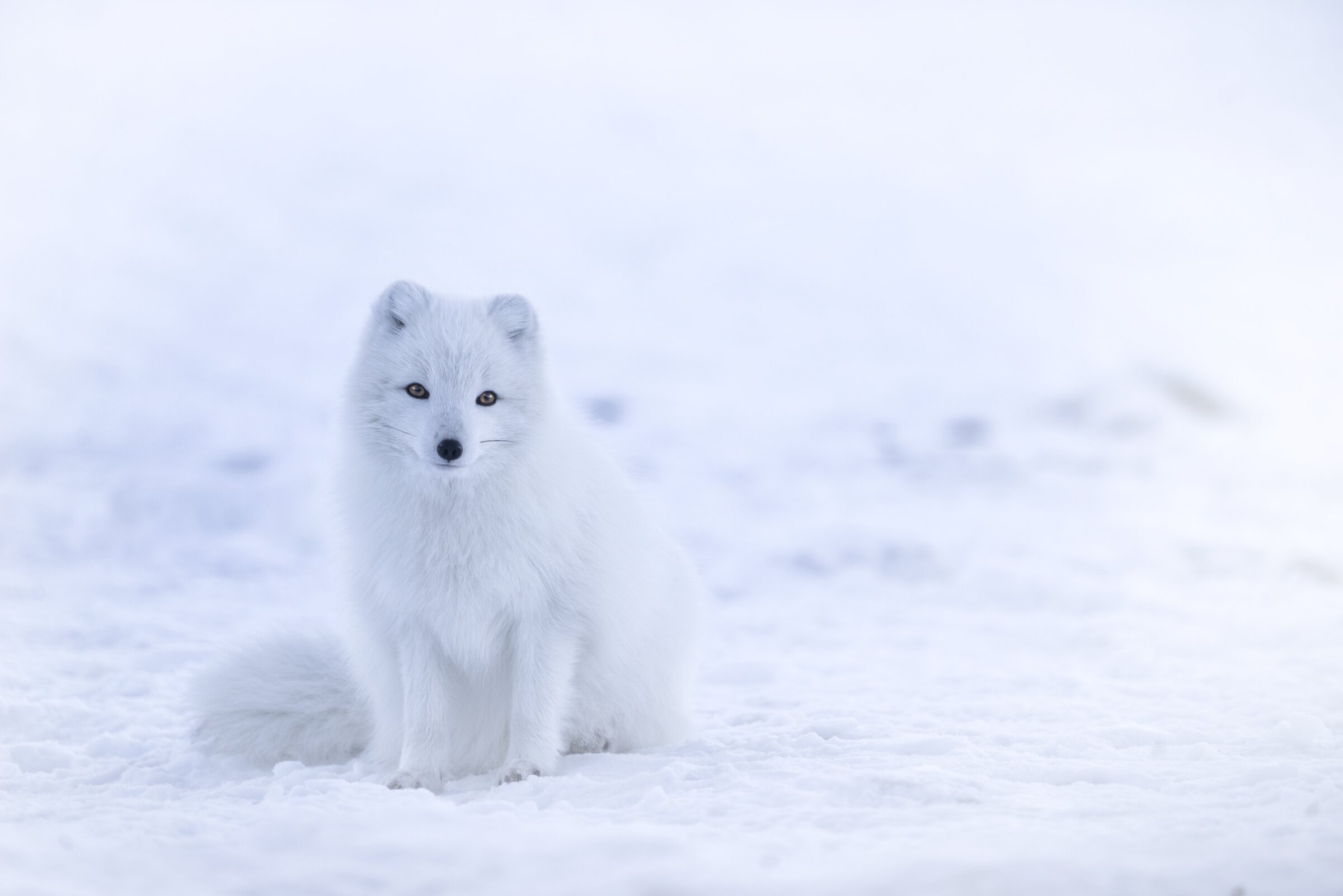
Before the records
When people began settling Iceland in the late ninth century, the Arctic fox was already here. The clearest physical evidence comes from a small cave exposed during roadworks at Hvalsárhöfði in north-west Iceland in 2004. Six fox skulls recovered there were radiocarbon dated to roughly 3,300–3,600 years ago.
The discovery ended one old argument: the fox was not brought to Iceland by people. It did not settle the island in the Viking Age, as some legends claimed, and it is not a feral remnant of human arrival. Exactly when and how the first foxes reached Iceland remains uncertain, but their history on the island is much older than its written history.
Written into the law
Iceland’s earliest lawbook offers the first written glimpse of that relationship. Grágás, written down in the early twelfth century after generations of oral transmission, stated that foxes could be hunted anywhere. The rule suggests an animal already common enough to be treated as part of the settled landscape.
The contrast is revealing. The same legal tradition prohibited the import of red foxes, wolves and brown bears. The Arctic fox was neither protected as a rarity nor excluded as a foreign predator: it was the native carnivore that farmers already knew, used and tried to control.
Evidence, law and attention
- c. 3,500 years ago
- The oldest directly dated fox remains yet found in Iceland.
- Early 1100s
- Grágás records the right to hunt foxes anywhere.
- 1295
- A record ties organised fox hunting to the number of sheep kept.
- 1958
- National hunting records begin, creating a long biological record.
- 1994
- A new wildlife act establishes protection, with exemptions to prevent damage.
- 2010
- The Arctic Fox Centre opens in Súðavík.
Fur, farms and obligation
For rural communities, the fox was both a resource and a risk. Its winter pelt had value, while its visits to sheep country, eider colonies and stores of food brought it into conflict with people. Hunting therefore joined private need to public duty.
A record from 1295 describes hunters being hired in proportion to the number of sheep farmed. Over the centuries the methods, rewards and institutions changed, but payment for foxes continued in different forms. Den hunting became specialised work, and knowledge of tracks, terrain and animal behaviour passed between generations.
This was never a single national attitude. A fox could be admired for its endurance, pursued for its skin, blamed for a loss or read as a sign of conditions on the land. The many Icelandic names for the animal preserve that mixture of close observation, humour and hostility.
A fox in heroic form
The late-medieval poem Skaufalabálkur turns that familiar adversary into a literary character. Probably composed in fifteenth-century western Iceland, it follows an old fox on his final hunting journey and tells the episode in the mock-serious language of heroic epic.
The poem is funny, but its detail matters. Sheep, dogs, shepherds and farm buildings appear from the fox’s side of the encounter. The animal remains a raider, yet it is also resourceful, experienced and doomed—a protagonist rather than a simple villain. That double image has endured in Icelandic culture.
Control becomes a record
Fox control became more coordinated in the twentieth century. Since 1958, the Icelandic state has collected hunting returns, producing one of the longest continuous sources for understanding changes in the population. Carcasses supplied by hunters later became research material, yielding evidence about age, diet, condition, fertility, colour and distribution.
The record is an uncomfortable but important one. The same system intended to reduce fox numbers also made long-term population research possible. It shows how the history of the species cannot be divided neatly into people who hunted and people who studied: field knowledge, policy and science have repeatedly overlapped.
Protected, with exceptions
The Wildlife Act of 1994 changed the legal frame. Wild mammals are protected in principle, but the law allows exemptions when hunting is used to prevent damage. In practice, foxes are still hunted across much of Iceland, while national parks and nature reserves provide the main areas of protection. Hornstrandir is the most significant refuge.
This distinction explains an apparent contradiction. The Arctic fox is not considered endangered in Iceland, yet it can be both legally protected and legally hunted. Conservation status, livestock policy and local experience answer different questions, and the argument over how they should be balanced remains part of the fox’s history.
From reputation to research
Long-term work by biologist Páll Hersteinsson helped move public discussion toward evidence about ecology, movement and population change. In 1998 he and Ester Rut Unnsteinsdóttir began studying foxes together in Hornstrandir. Their work led to the Arctic Fox Centre, established as a non-profit in 2007 and opened in Súðavík in 2010.
The newer chapter does not erase the older one. Hunting continues, farmers still report conflict, and wildlife tourism creates pressures of its own. What has changed is the range of ways the fox can be encountered: not only as quarry or threat, but as a native animal with a measurable ecology and a history inseparable from Iceland’s own.
Sources and further reading
The prose above is original and was prepared from the historical, scientific and institutional sources below.
- Hersteinsson et al. — The oldest known remains of Arctic foxes in Iceland
- Natural Science Institute of Iceland — Melrakki
- Sayers & Haukur Þorgeirsson — The Fox as a Dying Hero
- University of Iceland — A pioneer in research on the fox
- Arctic Research Consortium of the United States — Icelandic Research Centre Supports Unique Study of the Arctic Fox
- The Arctic Fox Centre — History of the Centre
- Alþingi — Act no. 64/1994 on wild birds and wild mammals