Here before us
The Arctic fox was established in Iceland long before human settlement. Exactly how it arrived is still uncertain. The leading explanation places its arrival near the end of the last Ice Age, when foxes followed suitable habitat north as the climate changed and the ice retreated.
The oldest fox remains found in Iceland are about 3,500 years old. Genetic research shows that the Icelandic population has also been largely separated from other Arctic fox populations since the end of the Ice Age. Open ocean now surrounds it: the same barrier that isolates the fox has helped give the population its particular character.
Built to retain heat
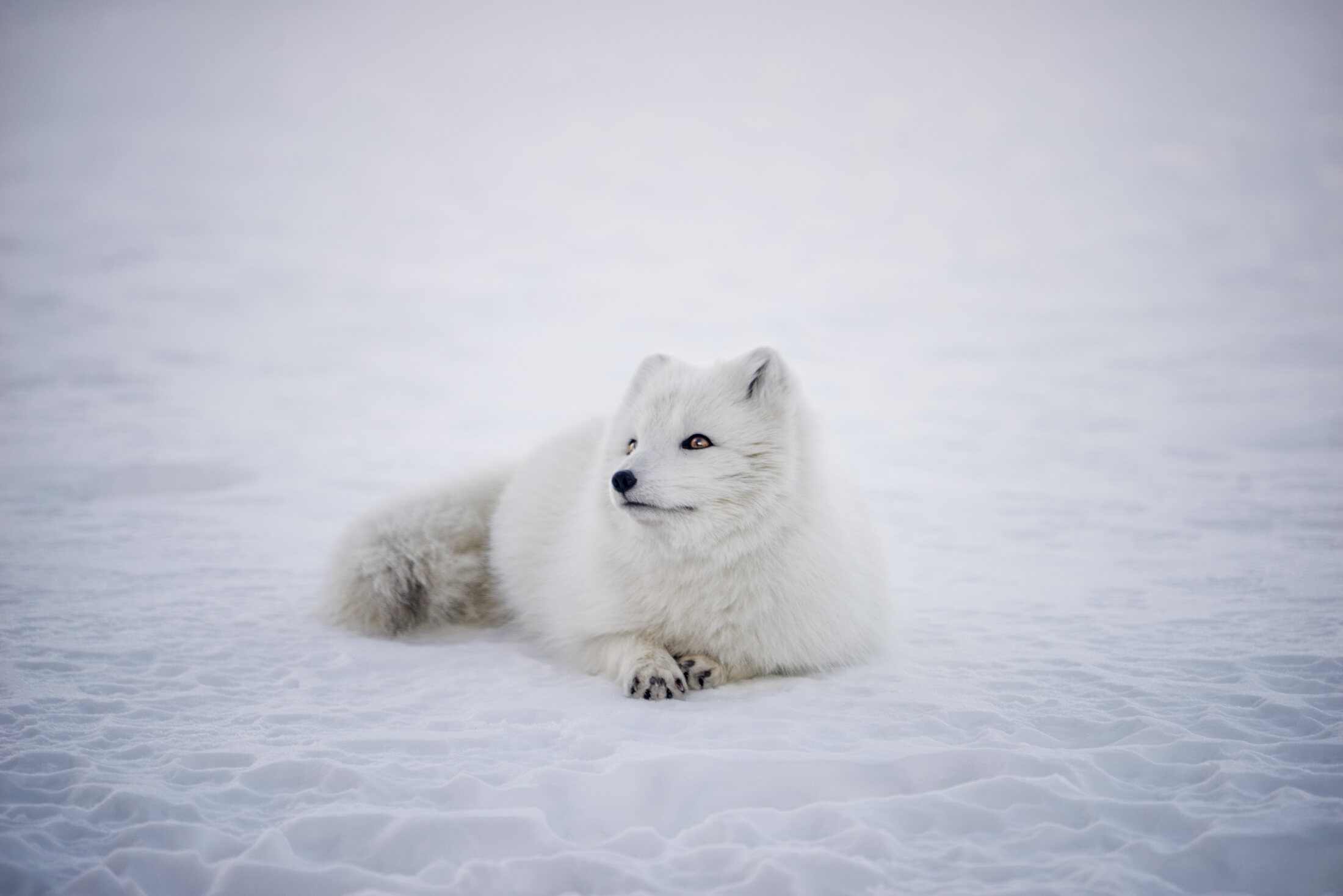
The body is compact, with short legs, a short muzzle and small rounded ears. Each feature limits the surface exposed to cold air. Dense fur covers the animal from nose to tail—including the soles of its feet.
Beneath the longer guard hairs lies an exceptionally fine undercoat that traps insulating air. In winter, that coat is sufficient for the fox to maintain its body temperature without raising its metabolic rate at temperatures down to roughly −35°C. A heat-exchange system in the legs helps conserve warmth while the fox stands and travels on frozen ground.
White and blue
Icelandic Arctic foxes occur mainly in two colour forms. The white morph becomes almost entirely white in winter and grey-brown across the back in summer. The blue morph remains brown, charcoal or silver-grey throughout the year, although its coat also changes in length and density with the seasons.
The balance between the two forms varies across Iceland. Darker foxes are especially common along productive coasts, while white foxes are encountered more often in parts of the interior and east. Colour is therefore more than appearance: its geography hints at habitat, movement and the degree to which foxes remain tied to particular regions.
One animal, many names
Refur and tófa are the familiar modern names, while melrakki is among the oldest recorded. Icelanders have also called it dratthali, gráfóta, holtaþór, skaufhali and skolli. A female is a læða, a male a steggur, and a pup an yrðlingur. The vocabulary records centuries of attention—admiration, suspicion and practical knowledge alike.
An island diet
Across much of the Arctic, fox populations rise and fall with lemmings. Iceland has no lemmings; the field mouse is the only rodent living wild on the island. Its foxes have instead become broad opportunists, eating what each landscape and season makes available.
Coastal foxes depend heavily on food connected to the sea: seabirds and their eggs, stranded marine animals, invertebrates and fish. Inland foxes rely more on migratory birds in summer, ptarmigan and carrion in winter, as well as insects and berries. Food is cached during times of plenty and recovered when winter narrows the menu.
Pair, territory and den
The basic social unit is a breeding pair rather than a pack. A pair defends a territory containing the food and shelter needed to raise young, often with several possible dens inside it. Dens range from a single opening to extensive systems used by successive generations.
Mating takes place in March. After a pregnancy of just under two months, most females give birth around the middle of May. The pups depend entirely on their mother’s milk at first, but both parents bring food as the summer progresses. By autumn, the young must be ready for an Icelandic winter—and, eventually, to find territory of their own.
A population of its own
Long isolation has made Iceland’s fox population genetically distinct, but not a separate subspecies. Its biology reflects an unusual combination: a coastal Arctic environment, comparatively steady but strongly seasonal food, and the absence of lemmings, red foxes and other large terrestrial predators.
Understanding that combination matters. The Icelandic fox is neither simply a smaller version of the animals found elsewhere nor a timeless emblem untouched by change. It is a living population responding to weather, prey, hunting, tourism and a warming North.
Sources and further reading
The prose above is original and was prepared from the scientific and institutional sources below.